Disquiet
I want to look at black pictures
Hello, brief piece on Lis Rhodes ‘Disquiet’ which played as part of essay film festival last week. Been writing more frequently but most of it should be appearing elsewhere. Not much more to add than that frankly!
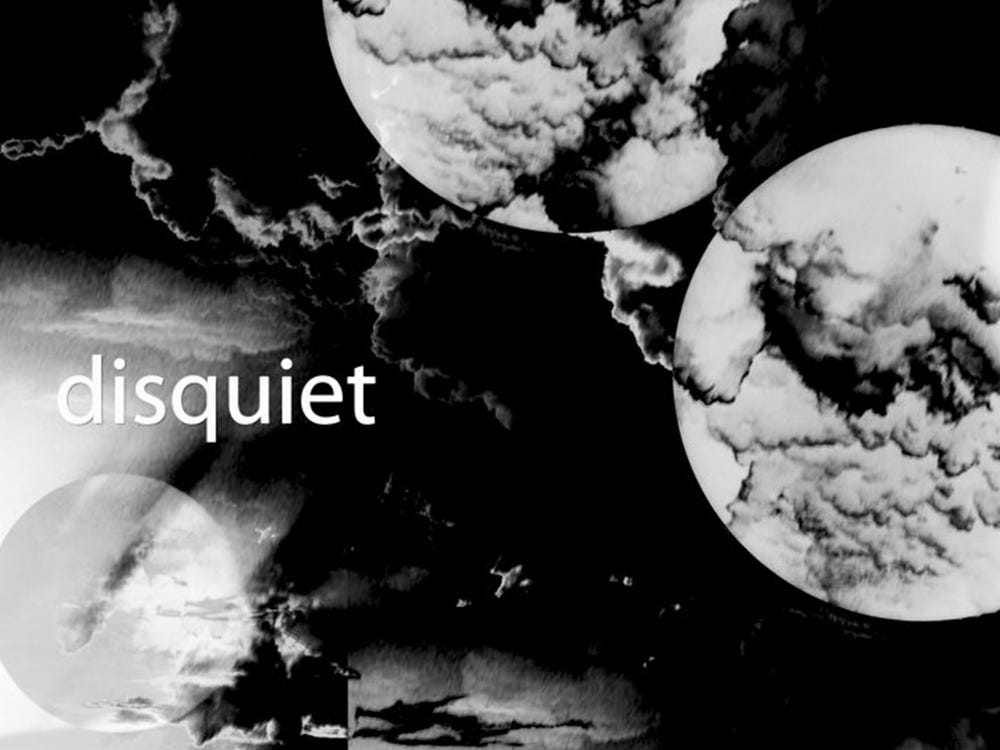
disquiet (Lis Rhodes, 2023)
Might be simplest to describe this as an extremely anticapitalist PowerPoint; whatever else there is to say Lis certainly 'goes in'. 80 something minutes detailing explicitly the continued theft and murder of the poor and powerless by the rich, from the level of individuals to nation states; all of these crimes fundamentally endemic to foundations of capitalism, occurring simply to enrich a few peoples and nations. Intended to be viewed in an installation setting Rhodes was apparently skeptical about a cinematic presentation. Certainly an initial experience of the visuals will not emphasise a particularly filmic quality. However, I think if anything is to be gained from disquiet it needs to be reckoned with as a matter of solidity. I can only imagine the experience of floating in midway, absorbing ten/twenty/thirty minutes, and moving on would be rather limpid.
I’m not too familiar with Rhodes more recent work but have been reliably told that in content and form disquiet is mainly in keeping with it; nonetheless, a brief description: windows movie maker style text is presented in poetic structuring conjoined (or illustrated) with black and white images (blood red is added a few times) usually made up of text, still photographic images and more abstract images. Of the latter Rhodes favours dense, tangled and complex imagery, appearing as innumerable strands of shading which cannot be comprehended. Sometimes these seem like composite images, others completely machine generated. Often, movement and dissonance within the image is achieved by a contortion and stretching these already unpalatable images too the point where they lose any trace of signification they may have had. Ugly and sometimes startlingly low res, their strangeness stuck with me for the next few days, until coming across something Sarah Hamblin wrote about the difficulty of representing the size, flux and complexity of modern finance capitalism offered one possible way in; the incomprehensibility of detail, form and evolution, achieving the same simple and obvious crime.
The figurative and found aspect of other images and text offer less to chew on; audio contextualises the photographs we see, photographs illustrate words. Having seen a Lis Rhodes film we should probably instinctively ask whose voice, whose text, whose history this is? It is not Rhodes job to teach us how to read (again), but the absence of ambiguity or need for interpretation does not necessarily reward such questioning here. Peppered with figures, stats and dates, the 'factual' texts have a journalistic quality accentuated by a certain getty images anonymity the figurative images which accompany them. Perhaps, the point is to make a subjective experience of these texts as difficult as possible, emphasised by the implicitly subjective ‘affected’ mode of poetic text, which creates a communal affect by removing the possibility of disparate readings; the audience being left in a vulnerable state of powerlessness, but reified in these alternating sensations of objective horror/subjective expression of horror is the sense that it is the communal we who are each and all under siege by these actions. This perhaps aims to establish a commune among the audience, but also explains why watching the film evokes something of the passive consumption cycle of 24 hour news.
If the spectator is to find the methods of resistance to answer this apocalypse it is only through an inability to find it. The majority of disquiet simply and angrily presents truths about the extent and horror of capitalist murder, but absent is the path forward: how resistance might be carried out? The establishment obviously has no interest in providing the keys to these doors and political art should not believe itself substitute for political action. The lack of encouragement, or impetus leaves a hollow which it is up to the audience to fill. returning us back to disquiet’s opening words: "the past can only warn it cannot prevent”. That the instinctual reaction to disquiet might be one of paralysis doesn’t seem optimistic for our chances of relighting the flame. Nonetheless, there is value in asking ourselves how we can look medusa in the face without turning to stone.
Other stuff I’ve been enjoying recently; listening to a lot of Sakamoto, mainly 12, BGM, Technodelic, Esperanto, and Casa; looking at a big chunky bullfinch today; Andre Nickatina’s 2000 album ‘Daiquiri Factory: Cocaine Raps, Vol. 2’.
Best, James